Vitreous Humor and Eye Floaters
The vitreous humor is a clear gel-like substance that is composed mostly of water and gives the eye its shape and form.
Vitreous Humor Function
Light enters the eye through the cornea, pupil, and lens, and is then transmitted through the vitreous humor to the retina.
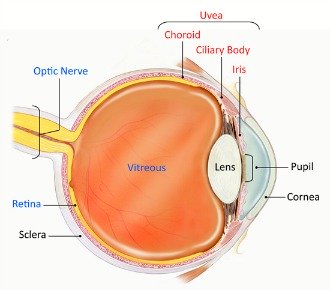
It fills the space between the lens and the retina (80% of the volume of the eyeball) which lines the back of the eye and helps to keep the retina in place by pressing it against the choroid. The space that it fills is called the vitreous body.
What Causes Eye Floaters?
There are millions of fine fibers in the vitreous humor. These fibers attach to the surface of the retina.
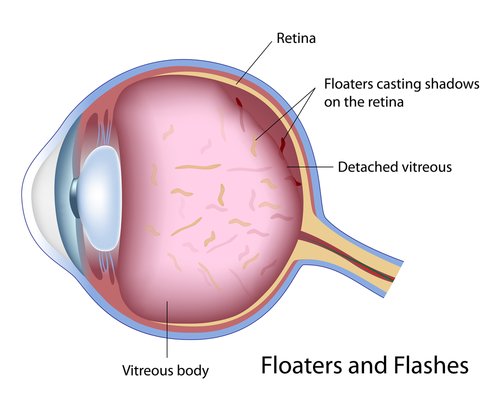
As we age,
the vitreous shrinks and
it becomes more liquid.
As it shrinks, these fibers that are attached to the retina pull away from the retinal surface and separate from the retina. This can cause vitreous floaters. The aqueous humor, the fluid in the front part of the eye, is continuously replenished. However, the gel in the vitreous body is not. Therefore, if debris from these tiny breaks in the retina get into the vitreous humor, they will remain there.

This debris or tiny specks of tissue are called floaters. They may look like dots, dust, cob webs or strings in your vision. You are actually seeing the shadow of this debris as light is cast onto your retina.
They can be annoying and interfere with your reading. However, most ophthalmologists consider them harmless and a normal sign of aging. Floaters in the eye can be a harmless, normal part of aging or the sign of a more serious eye condition.
Macular Degeneration Treatment and Floaters
"The syringes used to inject anti-VEGF agents are not designed for intravitreal administration. Some of them have been reported to release silicone droplets that have the potential to cause “floaters” that obstruct the patient’s vision.49 A recent study suggests the risk of silicone droplets is increased with certain syringe brands and flicking the syringe.55,56
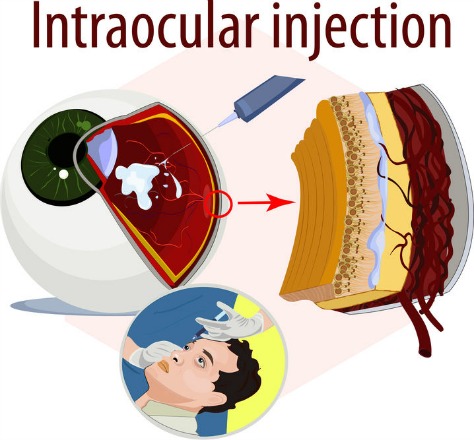
Among syringes available in the United States, silicone oil was released the most by Terumo 0.5 mL and BD Ultra-Fine 0.3 mL, and the least by BD Tuberculin 1 mL and Exel 0.3 mL.55"
Review of Neovascular Age-Related Macular Degeneration Treatment Options
Several readers have shared their experience with eye floaters following eye injections. You can read them here:
Vision Floaters Following Macular Degeneration Injections
Posterior Vitreous Detachment (PVD)
A posterior vitreous detachment (PVD) is a common condition seen in people age 60 and older and increasingly more common after age 80. This detachment is usually the result of normal, age-related changes in the vitreous gel in which the gel shrinks and separates from the retina.
It can also result from an eye injury or inflammation caused by surgery or disease. As you age, the vitreous gel in the middle of your eye begins to change. Parts of the gel shrink and lose fluid.
When these changes cause the vitreous gel to shrink suddenly and
separate from the retina it is called a posterior vitreous detachment.
Posterior vitreous detachment usually does not cause any problems, but it can increase your risk for a retinal detachment or sometimes cause tears in the retina.
At points where the vitreous gel is strongly attached to the retina, the gel can pull so hard on the retina that it tears the retina. The tear then allows fluid to collect under the retina and this may lead to a retinal detachment. The main symptoms of PVD is a
sudden increase in the number of new floaters and
flashes of light.
A sudden increase in the number of floaters is a symptom of a posterior vitreous detachment. If a person has a PVD in one eye they are at a higher risk of having one in the other eye. This was true for my husband. He had a PVD in his left eye and a year later another one in his right eye.
It is important to have these symptoms checked and examined immediately. A sudden change in these symptoms could be a warning sign of a retinal tear or detachment.
The flashes of light and annoying floaters should lessen after about a month. Some eye doctors recommend that the patient avoid physical activities for the first week or two after the PVD.
Retinal Tear Symptoms
Seeing floaters and flashes are often a normal sign of aging. However, there are times that such symptoms can indicate a more serious condition such as a retinal tear.
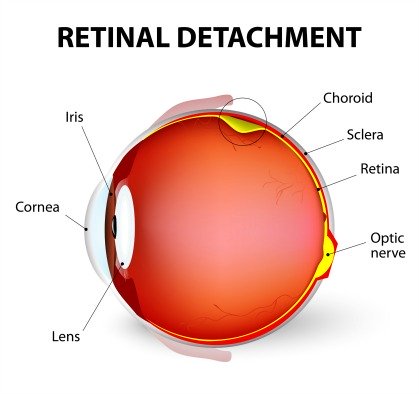
When the vitreous gel shrinks, if the tugging or pulling on the retina is more sudden rather than gradual, a retina tear can develop. When my husband was examined by a general ophthalmologist for his PVD she was not certain that there wasn't a slight retinal tear and referred my husband to a retina doctor.
If fluid gets in the tear or hole it can build up behind the retina and lift it up. When this happens the retina detaches. The retina then loses it's source of blood supply and nutrition which results in a severe loss of vision.
Sometimes the vitreous fibers can pull so hard on the retina that they create a macular hole or lead to a retinal detachment.
Either of these are an emergency and require that you immediately contact your ophthalmologist for an evaluation and treatment. A macular hole or detached retina can lead to permanent vision loss if it is left untreated. If you notice:
a sudden increase in floaters or
an increase in flashes of light in peripheral vision
an appearance of a curtain over the field of vision
you must see an eye care professional immediately.
The only way to diagnose the cause of the problem is by a comprehensive dilated eye examination.
If the vitreous detachment has led to a macular hole or detached retina, early treatment can help prevent loss of vision.
Go from Vitreous Humor to Eye Health Tips
Go from Vitreous Humor to WebRN Macular Degeneration Home

√ Prevention of Macular Degeneration?
√ Tips for Daily Living?
√ Food Suggestions for a Macular Degeneration Diet?
√ Ideas on Visual Aids to Maximize your Sight?
If you said "yes" to any of the above, sign up for the monthly Macular Degeneration News.


